
2026 An Adapter-Enhanced, Fourier Feature Deep Operator Network for Fault Severity Estimation of Stator Inter-Turn Short Circuits in Induction Motors
본문
- Journal
- Engineering Applications of Artificial Intelligence
- Date
- 2026-04
- Citation Index
- SCIE (IF: 9.0, Rank: 3.1%)
- Vol./ Page
- Vol. 170, pp. 114197
- Year
- 2026
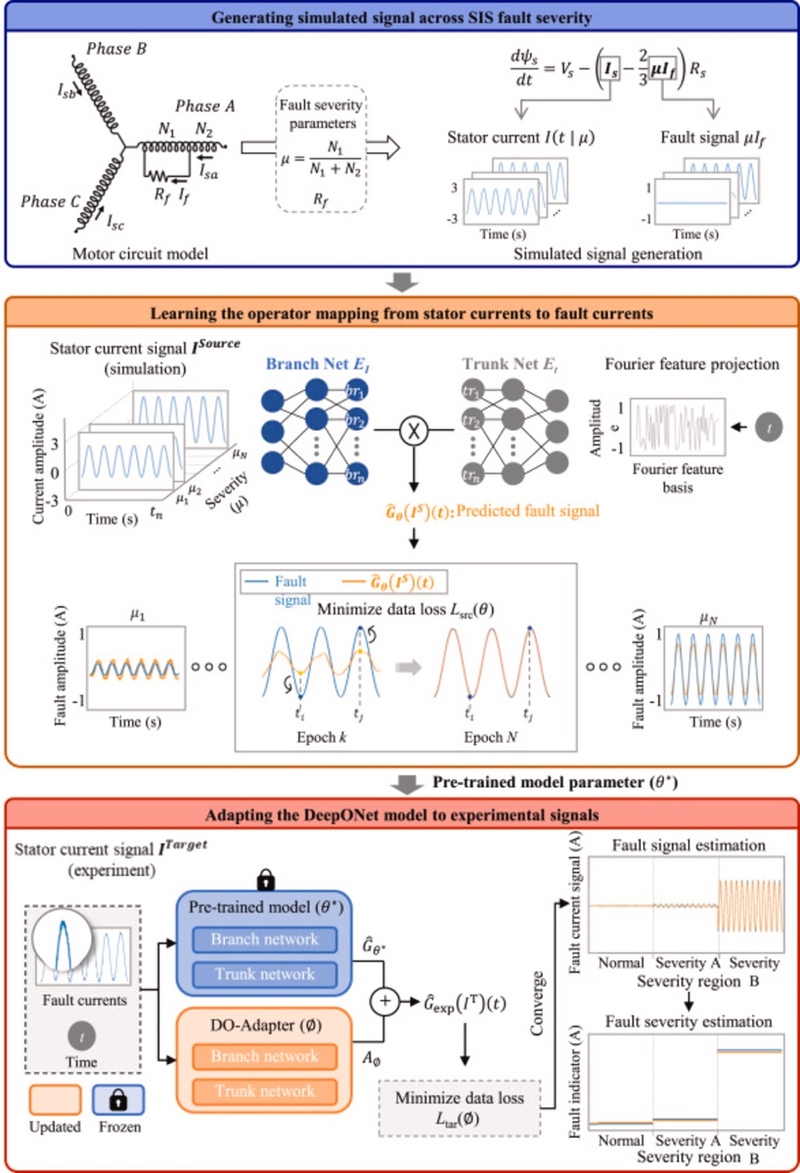
Conventional deep learning approaches for estimating stator fault severity in induction motors often struggle to generalize to unobserved severity levels, particularly in extrapolation scenarios. The Deep Operator Network (DeepONet) has emerged as an operator learning framework, capable of approximating nonlinear mappings between function spaces and generalizing to unseen input functions. However, when a simulation-trained DeepONet is fine-tuned using limited experimental data, the scarcity of severity levels often leads to overfitting, thereby undermining the extrapolative capability acquired during simulation training.
To address this limitation, an Adapter-Enhanced, Fourier feature Deep Operator Network is proposed. First, the base DeepONet is trained on simulation data to learn an operator that maps stator current signals to corresponding fault-related currents, thereby enabling severity extrapolation. To correct prediction residuals arising when applying the simulation-trained model to experimental signals, a parameter-efficient DeepONet-structured adapter is introduced. This adapter approximates a residual operator by mapping experimental stator currents to the discrepancies between simulation-trained predictions and ground-truth fault currents. It thereby enables residual prediction on previously unseen experimental stator currents. By freezing the simulation-trained model and updating only the adapter, the framework retains its extrapolation capability while adapting effectively to experimental data. Fourier feature embeddings are further applied to time coordinates to stabilize training and enhance extrapolation performance. The method is validated on simulated and experimental datasets at multiple motor speeds. Results show that it significantly outperforms comparison models in severity extrapolation and markedly reduces prediction residuals on experimental signals.