
2026 Time-Domain Signal Denoising and Expert Decision-Support Visualization with AttenTDNet for High-Voltage Power-Cable Joint-Box Monitoring
본문
- Journal
- Electrical Engineering
- Date
- 2026-08
- Citation Index
- SCIE (IF: 2.7, Rank: 50.3%)
- Vol./ Page
- Vol. 108, pp. 364
- Year
- 2026
Abstract
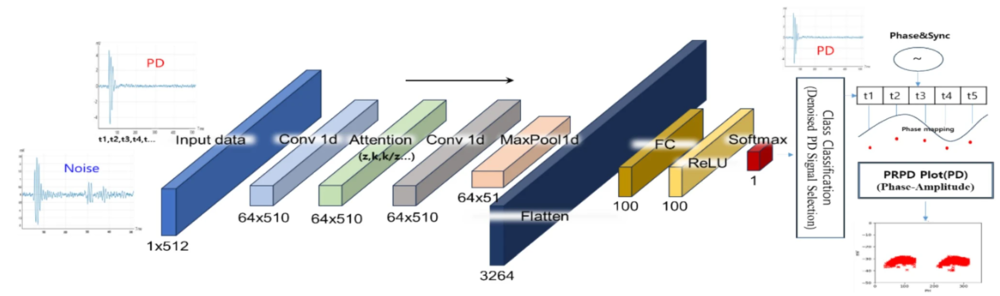
Partial discharge (PD) diagnosis using high-frequency current transformers (HFCTs) has been widely adopted for detecting insulation faults in power-cable joint boxes. However, HFCT measurements are highly susceptible to noise under field conditions, which affects PD–noise separation. Physics-based approaches, such as resistor–inductor–capacitor-based modeling, can effectively capture PD transient characteristics (e.g., fast rise times and high-frequency components). Nevertheless, their strong dependence on cutoff-frequency selection limits robustness across diverse noise environments. Conventional convolutional neural networks (CNNs) achieve enhanced classification performance by learning data-driven features; however, they treat all temporal regions uniformly and do not explicitly incorporate physically meaningful waveform segments, thereby limiting generalization capability. To address these limitations, we proposed an attention-based time-domain network (AttenTDNet), integrating physical PD characteristics with deep learning. By selectively emphasizing salient temporal regions associated with PD characteristics, AttenTDNet achieves robust and interpretable PD–noise separation. This framework leverages a one-dimensional CNN backbone combined with an attention mechanism guided by physical insight, bridging the gap between physics-based signal analysis and data-driven learning. Its performance was validated using four datasets representing early-stage insulation degradation and advanced breakdown conditions, as well as onsite measurements from real field environments. AttenTDNet consistently outperformed clustering-based and CNN methods in comparative analyses, particularly under low-signal and early-stage conditions. Integrating phase-resolved PD visualization with gradient-weighted class-activation mapping improved interpretability, confirming that the network focused on signal regions consistent with expert judgment. Thus, AttenTDNet offers improved accuracy, robustness, and transparency for practical PD diagnosis, supporting highly reliable insulation-condition assessment in power systems.