
2026 A Robust Deep Learning Framework for Weld Defect Classification in PAUT With Specimen-Level Preprocessing
본문
- Journal
- NDT & E International
- Date
- 2026-10
- Citation Index
- SCIE (IF: 6.0, Rank: 9.5%)
- Vol./ Page
- Vol. 164, pp. 103840
- Year
- 2026
Abstract
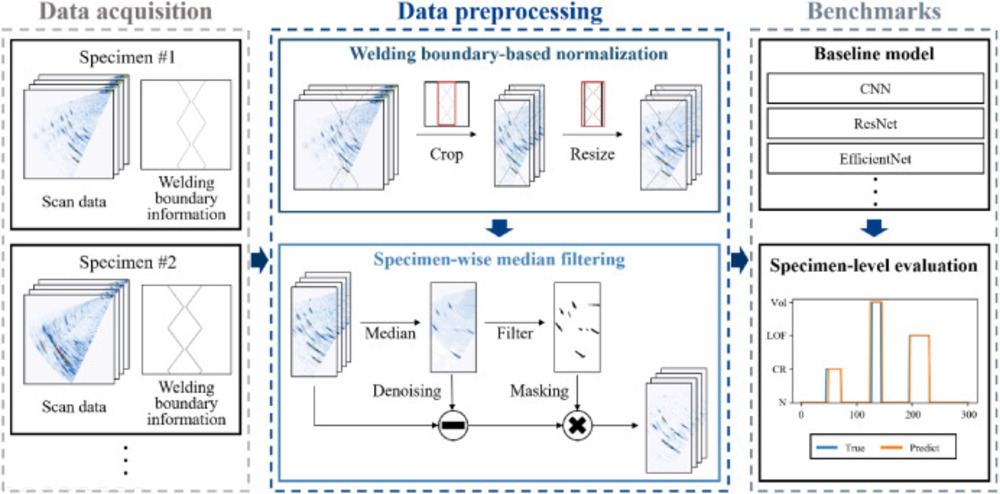
Phased array ultrasonic testing (PAUT) is widely utilized non-destructive testing (NDT) method in welding inspection; however, it requires considerable expertise and substantial analysis time for the defect evaluation. To address these challenges, extensive research has been conducted on automating PAUT inspection using artificial intelligence (AI). However, existing AI-based approaches are frequently overfitted to limited training data, resulting in performance degradation on unseen data. This limitation is particularly critical in PAUT, where inspection data are highly sensitive to variations in specimen characteristics, potentially producing numerous spurious echo features being generated from the geometry around the weld boundary. In response to this challenge, this study proposes a robust deep learning-based PAUT inspection framework that incorporates specimen-level preprocessing to effectively suppress specimen-induced interfering echoes and improve defect identification accuracy. The proposed framework comprises two key components: welding boundary-based normalization and specimen-wise median filtering, which serve to standardize data geometry and reduce the impact of geometric echoes and noise across specimens. The model's generalization capability is validated through specimen-level train-test separation, demonstrating the superior performance of the proposed method. These findings are expected to significantly advance the practical industrial application of AI-based automated PAUT inspection systems.