
2026 Structural Dependency-Aware Generative Design of Elastic Metasurfaces via Pseudo-Supervised Attention-based Transformer
본문
- Journal
- Computer Methods in Applied Mechanics and Engineering
- Date
- 2026-08
- Citation Index
- SCIE (IF: 7.3, Rank: 2.6%)
- Vol./ Page
- Vol. 458, pp. 119041
- Year
- 2026
Abstract
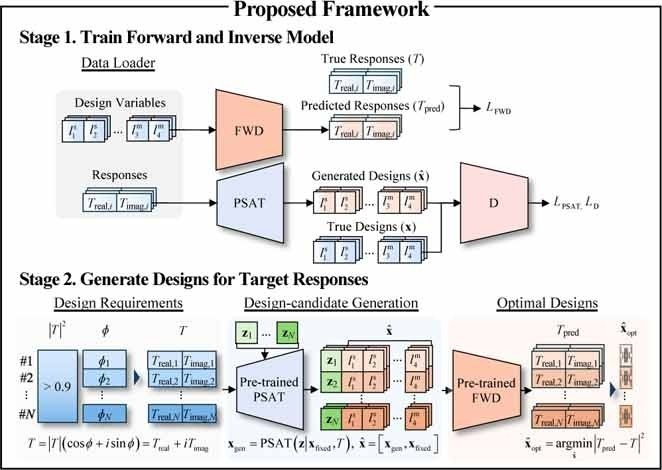
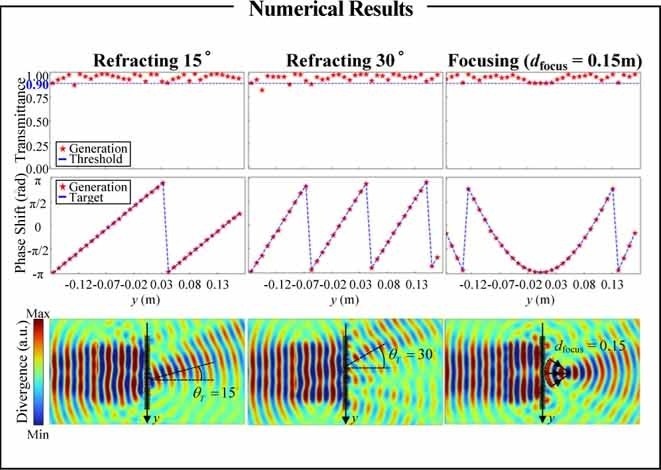
Elastic metasurfaces exhibit extraordinary wave-manipulation functionalities through compact architectures by tailoring the spatial phase profiles of reflected and refracted waves. Their functionality is inherently design-driven, requiring coordinated unit-cell designs to achieve prescribed wavefront responses. However, existing inverse design approaches based on analytical models, genetic algorithms, or hybrid deep learning frameworks often struggle with strongly coupled design variables, strict physical constraints, and the efficient generation of multiple unit-cell arrays. To address these challenges, this study presents a fully data-driven inverse design framework based on a pseudo-supervised attention-based transformer (PSAT). The proposed framework uses latent vectors to handle one-to-many mappings and promote design diversity. It also jointly trains forward and inverse models to improve computational efficiency. PSAT reformulates inverse design as a dependency-aware generation problem, directly mapping prescribed phase profiles to physically consistent unit-cell geometries without an iterative search. Through a pseudo-design representation and pseudo-supervised attention mechanisms, PSAT enables fully parallel generation while preserving geometric feasibility. The framework is validated through full-wave simulations of elastic metasurfaces for anomalous refraction and wave focusing, demonstrating accurate wave control with high transmission performance. These results confirm that PSAT is a reliable, efficient inverse design approach for custom metasurface engineering and an effective alternative to traditional optimization-based methods. To ensure the reproducibility of the results, the source code and datasets are available at https://github.com/taehun-k/psat