
2026 Frequency-Band Graph-based Sensor Fusion with Sensitivity-aware Energy Assist Network for Machinery System Fault Diagnosis
본문
- Journal
- Engineering Applications of Artificial Intelligence
- Date
- 2026-09
- Citation Index
- SCIE (IF: 8.0, Rank: 2.6%)
- Vol./ Page
- Vol. 179, pp. 115273
- Year
- 2026
Abstract
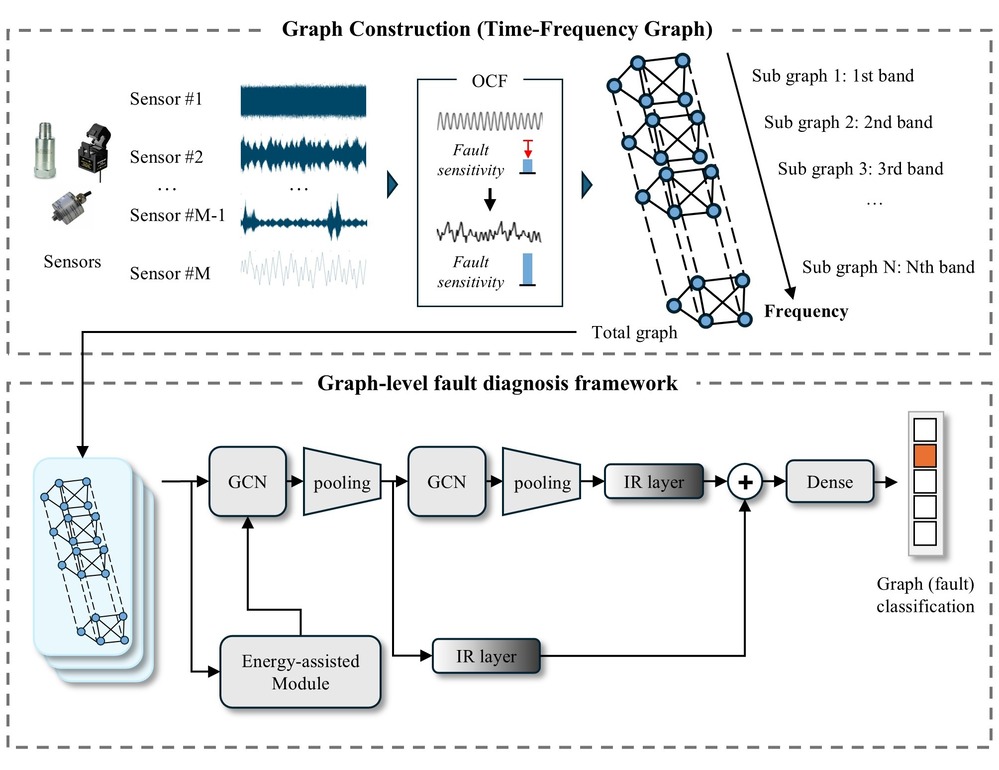
Graph-based fault diagnosis methods have shown capabilities in multi-sensor data fusion by representing the hidden relationships between sensors. However, their effective application in complex machinery systems remains challenging. First, constructing a graph that fully captures system-level fault characteristics is difficult, as fault-related features in signals are often subtle and widely distributed across multiple frequency bands. Second, learning accurate and efficient graph representations during model training is hindered by the fact that sensor signals exhibit varying sensitivities to different fault modes, and each fault mode presents distinct frequency-domain behaviors, such as energy shifts or unique fault frequencies. To overcome these challenges, this article proposes frequency-band graph-based sensor fusion with sensitivity-aware energy assist network (FBG-SEANet), a newly developed graph-based sensor fusion framework. The frequency-band graph (FBG) is a novel graph construction strategy that decomposes sensor signals into multiple frequency bands, builds a subgraph for each band, and connects them to form the final graph, thereby preserving subtle fault features distinctive to each band. Using the FBG as input, the sensitivity-aware energy assist network (SEANet) is designed with a sensitivity-aware readout (SR) layer to capture signal sensitivity to each fault. In addition, an energy assist (EA) module is employed to learn fault features associated with energy shifts in the signals. Validation is carried out using one open rotating machinery dataset, one motor experimental dataset, and one urban air mobility (UAM) system experimental dataset. The results show that FBG-SEANet improves multi-sensor data fusion and outperforms conventional sensor fusion models with enhanced explainability.